
Best overall: a brand-matched 877 vanity number. Best for membership subscriptions: SUBCLUB. Best for phone-first sales: a repeated-digit pattern. The best 877 number ideas for subscription businesses make your contact number easier to say, remember, and connect with your business—not just your first offer.
- The best 877 number ideas for subscription businesses start with a recognizable brand or a clear subscription category.
- 800andlocalnumbers sells memorable numbers through a one-time purchase; ongoing phone service comes from your carrier.
- SUBCLUB, BOXHELP, PETCLUB, and FITPLAN are seven-letter concepts, not specific numbers offered for sale.
- Compare 877 vanity numbers, premium 800 numbers, and local area codes before choosing your pattern.
Why this matters
A subscription business needs a number that still fits after the first sale. Customers might call about joining, changing an order, updating billing, or ending a subscription. A narrow campaign phrase does not cover all those conversations.
800andlocalnumbers is a fit for subscription businesses seeking a one-time purchase of a memorable phone number, separate from carrier service. Start your 2026 shortlist with the toll-free, vanity, and local number options, then choose the pattern that matches how customers know you.
The concepts below are selection ideas—not named products or complete telephone numbers.
What makes the best subscription business number?
Use these criteria before choosing a word or digit pattern:
- Brand fit: Customers should connect the number with your business, not another category.
- Spoken clarity: Someone hearing the number should know what to dial without a spelling lesson.
- Keypad fit: A standard vanity number uses 7 letters after the toll-free prefix, corresponding to 7 digits.
- Room to grow: The phrase should survive changes to your subscription products or plans.
- Transfer fit: Confirm that your chosen carrier can accept and support the specific number before purchase.
- Purchase clarity: Separate the one-time number purchase from the carrier's ongoing service charges.
Do not rank your 2026 choices by cleverness alone. Read each candidate aloud, spell it on a phone keypad, and ask whether it still describes the business you intend to run.
Best 877 number ideas at a glance
These recommendations rank number concepts, not competing phone-service providers. Every word concept below contains seven letters; spaces simply make the words easier to read.
| Rank | Number concept | Best for | Standout feature | Key limitation |
|---|---|---|---|---|
| 1 | Brand-matched vanity | Businesses with a distinctive, keypad-friendly name | Connects the number directly to the business | Longer names need a shorter form |
| 2 | SUBCLUB | Membership-led subscriptions | Expresses a subscription community | Does not identify the product category |
| 3 | BOXHELP | Shipped subscription customer support | Gives the number an obvious support purpose | Less suited to acquisition campaigns |
| 4 | PETCLUB | Pet-focused subscriptions | Names both the audience and membership model | Restricts the number to a pet-related identity |
| 5 | FITPLAN | Fitness subscription programs | Connects fitness with an ongoing plan | Does not explain the program format |
| 6 | Repeated-digit pattern | Businesses selling through spoken conversations | Customers can hear the digits directly | Does not communicate a brand or category |
1. Brand-matched vanity: best for a distinctive business name
A brand-matched vanity number spells your business name or an established short version. It is the strongest default when customers already recognize that name and can spell it without help.
Build your 2026 shortlist around the name customers actually use. Do not introduce a new nickname just to make the letters fit.
Brand-matched vanity pros:
- Connects the number directly to your business.
- Works across sales and customer support.
- Does not tie the number to a particular subscription product.
Brand-matched vanity cons:
- Names longer than seven letters need a shorter form.
- Unusual spellings require explanation.
Best for: Subscription businesses with a distinctive name that fits the standard vanity format.
Verdict: Buy the brand-matched pattern when the spelling is clear and the carrier accepts the number.
2. SUBCLUB: best for membership-led subscriptions
SUBCLUB combines a subscription reference with the idea of membership. It fits a business that genuinely presents its offer as a club, rather than simply charging customers on a recurring basis.
The phrase does not explain what you sell. Use it beside your business name and a clear product description.
SUBCLUB pros:
- Contains seven letters without shortening either word.
- Expresses a membership concept.
- Leaves the product category open.
SUBCLUB cons:
- SUB can mean something other than subscription.
- The phrase does not identify your business by itself.
Best for: Subscription clubs whose membership positioning already appears in their customer communications.
Verdict: Buy this concept for a real club offer; skip it when customers never hear your business described that way.
3. BOXHELP: best for shipped subscription support
BOXHELP gives a shipped subscription business a clear support-oriented phrase. It fits conversations about recurring boxes, order changes, and delivery questions.
Choose the concept because support is the number's job—not because every subscription business needs the word HELP. A sales-led number needs a different emphasis.
BOXHELP pros:
- States a recognizable reason to call.
- Fits packaging and order-related communications.
- Avoids tying the number to one item inside a box.
BOXHELP cons:
- Sounds like a support line rather than a sales line.
- BOX does not describe digital subscriptions or unboxed services.
Best for: Businesses that ship recurring boxes and want a dedicated customer support identity.
Verdict: Buy this concept for box-related support; skip it for a general membership sales number.
4. PETCLUB: best for pet-focused subscriptions
PETCLUB combines a clear customer category with membership language. It fits a pet subscription business whose customers already understand the offer as a club.
The phrase gives you category clarity but not a unique business identity. Keep your business name beside it wherever you publish the number.
PETCLUB pros:
- Identifies the pet category immediately.
- Fits a recurring membership message.
- Does not name one specific pet product.
PETCLUB cons:
- Does not distinguish your business from other pet clubs.
- Becomes a poor fit if the business expands beyond pets.
Best for: Pet-focused subscription clubs that intend to keep that category identity.
Verdict: Buy this concept for a lasting pet membership offer, not a temporary pet-product campaign.
5. FITPLAN: best for fitness subscription programs
FITPLAN pairs a fitness reference with the idea of an ongoing plan. It fits a fitness business whose subscription centers on a continuing program.
The phrase does not say whether that program includes coaching, classes, or digital content. Your accompanying copy still needs to explain the offer.
FITPLAN pros:
- Connects fitness with an ongoing program.
- Uses two short, familiar words.
- Avoids naming one exercise or training method.
FITPLAN cons:
- Does not identify the format of the subscription.
- Restricts the number to a fitness-related message.
Best for: Fitness subscriptions built around an ongoing plan rather than a single purchase.
Verdict: Buy this concept when PLAN accurately describes the subscription customers receive.
6. Repeated-digit pattern: best for spoken number sharing
A repeated-digit number uses a recognizable numerical pattern instead of a word. Consider it when staff routinely give the number during calls, appointments, presentations, or in-person conversations.
Say every digit during your evaluation. A pattern that looks tidy on a screen still needs to sound clear aloud.
Repeated-digit pattern pros:
- Avoids letter-to-number conversion.
- Does not depend on spelling a business name.
- Works without a category-specific phrase.
Repeated-digit pattern cons:
- Does not communicate what your business does.
- Long runs of identical digits require careful dictation.
Best for: Subscription businesses that regularly share their number verbally.
Verdict: Buy the pattern you can dictate clearly; skip patterns that require repeated correction.
Should you choose 877, premium 800, or a local number?
An 877 number is toll-free, not a local area code. An 800 number is also toll-free. A local number gives you a specific geographic area code instead.
For your 2026 purchase, compare the complete number—not just the prefix.
| Number type | Best for | Main advantage | Main limitation |
|---|---|---|---|
| 877 vanity | Businesses wanting a toll-free word pattern | Combines a toll-free prefix with a readable phrase | Requires customers to translate letters into digits |
| Premium 800 | Buyers specifically seeking the 800 prefix | Matches that exact prefix preference | The prefix alone does not explain the business |
| Local number | Businesses prioritizing a desired area code | Connects the number with a geographic area | One area code does not represent every market |
If a desired area code matters more than a word, shop for a local number first. If the 800 prefix is a firm requirement, compare premium 800 candidates rather than treating 877 as interchangeable with that preference.
Buy the number, then move it to your carrier
Your 2026 purchase decision has two separate parts: the number and the phone service. A one-time number purchase does not replace your carrier's ongoing service bill.
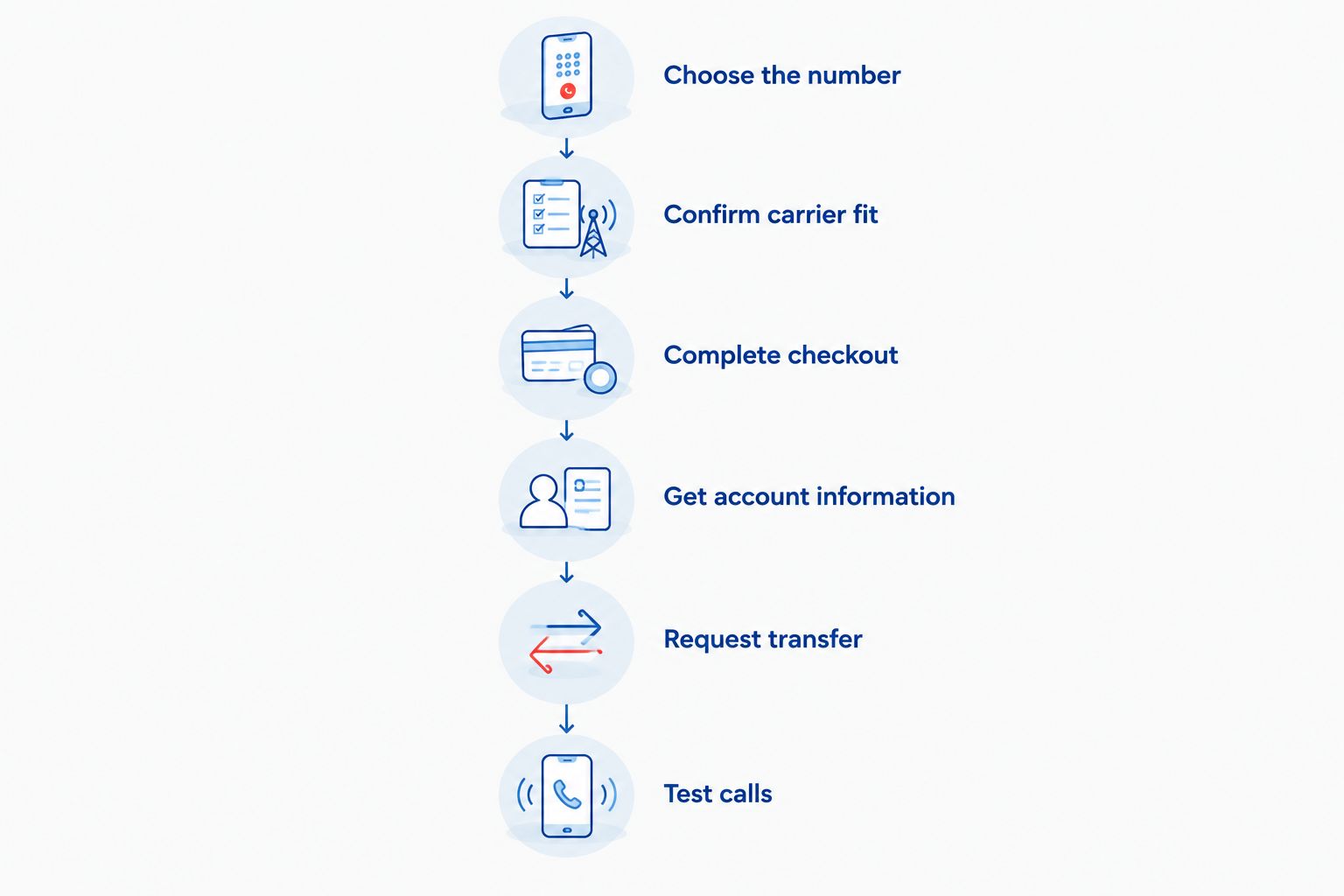
Use this sequence with 800andlocalnumbers:
- Choose the number. Decide on the prefix, word pattern, or desired local area code.
- Confirm carrier fit. Ask the receiving carrier about the exact number before checkout.
- Complete checkout. Review the one-time number charge separately from your service agreement.
- Get account information. Collect the transfer information associated with the purchased number.
- Request transfer. Give that information to your receiving carrier and follow its instructions.
- Test calls. Verify incoming calls after the carrier confirms activation.
Keep your existing business number working while the transfer is being arranged. Ask the receiving carrier when to change your published contact details; do not assume checkout means calls are already connected.
Find your business number
Compare toll-free, vanity, and local numbers for a one-time number purchase.
How these ideas rank
Brand fit comes first, followed by spoken clarity, keypad fit, and room to grow. These are buying recommendations based on the purpose of each pattern—not measured conversion results or claims that one phrase produces more calls.
For an undecided buyer, choose a clear brand-matched vanity number first. Choose a category phrase only when it describes the subscription accurately. Choose repeated digits when speaking the number matters more than spelling a word.
FAQ
What's the best 877 number idea for a subscription business?
A brand-matched vanity number is the best default when customers recognize and can spell your business name. SUBCLUB fits membership positioning, while BOXHELP fits shipped subscription support.
Is an 877 number a local number?
No. An 877 number is toll-free, not a geographic area code. Choose a local number when a specific area code is part of your buying requirement.
Is an 800 number better than an 877 number?
Choose 800 when that exact prefix is a requirement; choose 877 when the complete number better matches your business. Both prefixes are toll-free, so compare the full number rather than assuming the prefix decides the purchase.
How many letters should an 877 vanity number have?
A standard 877 vanity number has seven letters after the prefix, corresponding to seven digits. The complete standard number has ten digits, including the three-digit prefix.
Does buying a number include ongoing phone service?
No. At 800andlocalnumbers, the one-time number purchase is separate from ongoing phone service. You pay your carrier for service and arrange the number transfer with that carrier.
How do I check the total cost before buying?
Review the one-time number charge and your carrier's service terms separately. Ask the carrier about any transfer-related charges before completing the purchase.
Can I buy a local number with a desired area code instead?
Yes. Local numbers are part of the seller's offer. Start your search with the desired area code, then compare the remaining digits for spoken clarity and brand fit.
Should my subscription sales and support teams use the same number?
Use one general number when you want a single public contact identity, and confirm routing with your carrier. Choose a support-specific phrase such as BOXHELP only when that purpose should be clear before someone calls.
One last thing
Before publishing your new number in 2026, check the prefix as carefully as the word. The same seven-letter phrase with 877 and 800 produces different complete numbers. Read the full number back during purchase and transfer—not just the memorable ending.