
Best overall: a brand-led 888 number. Best for category recognition: a product-category word. Best for phone orders: an action-led phrase. The best 888 number ideas for e-commerce brands start with a name customers already recognize; 800andlocalnumbers sells memorable numbers for a one-time purchase, separate from your carrier’s ongoing phone service.
- The best 888 number ideas for e-commerce brands put recognizable brand words before clever spelling.
- 800andlocalnumbers sells memorable numbers through a one-time purchase; ongoing phone service comes from your carrier.
- Choose category words for product recognition, action words for orders, and support words for customer service.
- Compare an 888 pattern with premium 800 and desired-area-code local numbers before buying.
Why this matters
Your phone number needs to work on a package, in an email, and when someone reads it aloud. A clever phrase fails if customers cannot translate it into the right digits.
An 888 prefix is toll-free, not a local area code. It does not tell customers what your store sells or whether the line handles orders, returns, or general questions. The remaining digits—and the label beside the number—do that work.
For your 2026 purchase, choose a number you can explain once without correcting the spelling.
What makes the best 888 number ideas?
Use these criteria before comparing patterns:
- Recognition: Customers connect the word with your brand, products, or purpose.
- Spelling: The phrase sounds the way it is spelled. Avoid words that need an explanation.
- Length: A standard North American toll-free number has a 3-digit prefix followed by 7 digits. Build around those remaining digits.
- Purpose: The wording matches what callers can actually do on the line.
- Transfer fit: Your intended carrier confirms it can accept and support the number before you purchase.
- Purchase clarity: You understand the one-time number purchase separately from recurring phone service.
Do not make the prefix your only requirement. A clear numeric pattern beats a confusing vanity phrase.
888 number ideas at a glance
These are naming directions, not specific phone numbers or inventory listings. The order reflects practical selection criteria, not measured sales results.
| Rank | Number idea | Best for | Standout feature | Key limitation |
|---|---|---|---|---|
| 1 | Brand-led word | Stores with a recognizable, easy-to-spell name | Matches the name customers already know | Long names need shortening |
| 2 | Product-category word | Stores focused on a clear product category | Explains what the store sells | Restricts the message if the catalog changes |
| 3 | Action-led phrase | Businesses accepting orders by phone | Gives callers a clear instruction | Misleads if the line cannot take orders |
| 4 | Support-led phrase | Stores separating customer service from sales | Sets the purpose of the line | Does not communicate product range |
| 5 | Repeating numeric pattern | Brands whose names do not work on a keypad | Avoids spelling and letter mapping | Does not explain the business |
1. Brand-led word: best for established store names
Build the number around your store name or its clearest recognizable part. This keeps the phone number tied to the business rather than a campaign or temporary product line.
Best for: E-commerce brands with a short name customers can spell after hearing it.
Brand-led word pros:
- Connects the number directly to your store.
- Works across different product categories.
- Avoids tying the line to orders or support alone.
Brand-led word cons:
- Long names need abbreviation or a different approach.
- Unusual spellings create extra work for callers.
Read the name aloud without showing it to someone. Ask them to write it down, then map it to a telephone keypad. If you need to explain a missing vowel or substituted letter, choose another pattern.
Verdict: Buy a brand-led pattern when the spelling is obvious and the complete dialed number checks out.
2. Product-category word: best for focused catalogs
Choose a word that describes what customers buy. Terms such as PET, TEA, or RUG are starting points for brainstorming—not complete number recommendations.
The category should describe the store’s core business, not just its current bestseller. Your 2026 selection should still make sense when you add related products.
Best for: Stores whose product category is clearer than their brand name.
Product-category word pros:
- Gives unfamiliar customers useful context.
- Fits product-focused advertising and packaging.
- Avoids dependence on an unfamiliar brand spelling.
Product-category word cons:
- Broad terms do not distinguish your store from competitors.
- Narrow terms stop fitting when the catalog expands beyond them.
Write the intended phrase beside your store name. If it sounds like a different business, reject it. Also check that customers will not mistake a category-specific line for a separate company.
Verdict: Buy a category-led pattern when the category is central to the business, not a temporary collection.
3. Action-led phrase: best for phone orders
Use an action word when calling is part of the purchase process. SHOP and ORDER are useful brainstorming directions, but the complete phrase must fit the number and describe something your team actually handles.
A sales instruction belongs on a sales-capable line. Do not put an ordering message on a number that only handles existing purchases.
Best for: E-commerce businesses that accept orders or purchase questions by phone.
Action-led phrase pros:
- Tells customers what to do next.
- Fits advertising with a direct call-to-order message.
- Separates a sales line from an existing support line.
Action-led phrase cons:
- Creates the wrong expectation if staff cannot take orders.
- Sounds awkward beside returns or complaint instructions.
Before buying, decide who answers and what happens when the caller wants to purchase. The wording should match that process, including the message customers hear outside your answering hours.
Verdict: Buy an action-led pattern only when your phone process supports the action.
4. Support-led phrase: best for customer service
A support-led number uses a service word, such as HELP, as the starting point. It suits a dedicated line for order questions, returns, or product assistance.
The word identifies the purpose. It does not replace clear instructions about when and how customers can reach your team.
Best for: Stores keeping post-purchase questions separate from new sales.
Support-led phrase pros:
- Makes the line’s purpose clear.
- Fits order emails and customer-service instructions.
- Avoids presenting every customer interaction as a sales call.
Support-led phrase cons:
- Gives little information about your products.
- Fits a general sales campaign less naturally than a brand-led number.
Check the full phrase for unintended promises. Avoid wording that implies round-the-clock assistance or immediate answers unless your business provides them.
Verdict: Buy a support-led pattern for a dedicated service line; skip it as the default for a mixed-purpose number.
5. Repeating numeric pattern: best for difficult brand spellings
Choose a clear digit pattern when words create more problems than they solve. Repeated digits and recognizable groupings let you present the number without asking callers to translate letters.
Keep the same grouping wherever you publish it. Changing the spacing between packaging, ads, and email signatures makes the presentation inconsistent.
Best for: Brands with long names, unusual spellings, or a preference for digits over words.
Repeating numeric pattern pros:
- Avoids keypad letter conversion.
- Does not tie the number to a product category.
- Works without translating an English vanity word.
Repeating numeric pattern cons:
- Does not explain your brand or the line’s purpose.
- Similar repeated groups need careful proofreading.
Read every digit aloud. Repetition is not enough if listeners lose their place or confuse adjacent groups.
Verdict: Buy a numeric pattern when it is clearer than your best word-based option.
Compare 888 with premium 800 and local numbers
Keep the prefix decision separate from the wording decision. For a 2026 purchase, compare the complete number—not just its opening digits.
| Option | Best for | Main benefit | Main limitation |
|---|---|---|---|
| 888 toll-free | Businesses seeking a toll-free contact number | Supports word-based or numeric patterns | Does not identify a local market |
| Premium 800 | Businesses specifically seeking an 800 prefix | Matches an explicit prefix preference | The prefix alone does not make the remaining digits clear |
| Desired-area-code local | Businesses prioritizing a particular local market | Uses the area code you want customers to recognize | Does not function as a toll-free number |
A local number deserves serious consideration when your store serves a defined region or wants a particular area code. Choose the desired area code first, then assess the remaining digits for clarity. An area code does not establish a physical business location.
Premium 800 numbers deserve the same scrutiny as 888 numbers. Do not accept a confusing ending simply to get the prefix you prefer. Ask 800andlocalnumbers for help finding a specific number or area code, then evaluate the complete result.
Purchase the number, then arrange service
A one-time number purchase is not a phone-service subscription. You purchase the number from 800andlocalnumbers and pay your carrier for ongoing service.
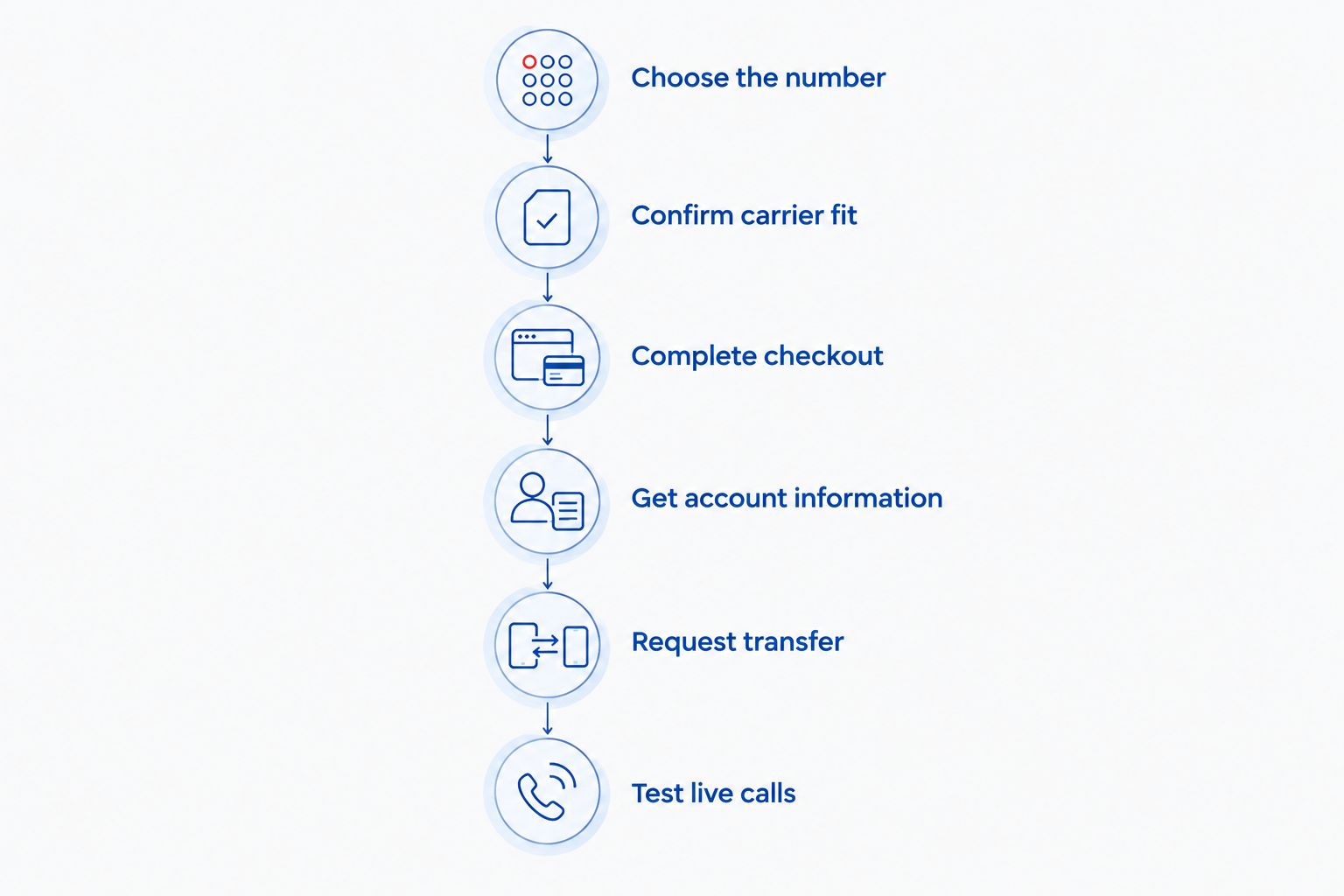
Use this sequence:
- Choose the number. Check the complete digits, intended wording, and purpose.
- Confirm carrier fit. Ask your intended carrier about accepting the number and supporting your requirements.
- Complete checkout. Review the one-time purchase terms separately from carrier service charges.
- Get account information. Obtain the transfer information provided after purchase.
- Request transfer. Give the required information to your carrier and follow its instructions.
- Test live calls. Confirm routing and answering before publishing the number widely.
Do not assume voice service includes texting or every feature your store needs. Confirm those requirements with the carrier before completing the purchase.
Keep your transfer details consistent with the information supplied. Ask your carrier how to handle any existing service before making cancellation changes.
Find your business number
Compare memorable toll-free and local numbers for a one-time purchase, separate from carrier service.
How these ideas are ranked
This 2026 ranking prioritizes recognition, spelling, purpose, and carrier fit. Brand-led wording ranks first because it connects the number to the store without limiting it to a product category or call type.
The ranking does not claim that a particular pattern increases sales. Choose the highest-ranked approach that passes your actual spelling and usage checks.
Which 888 number idea should you choose?
Start with your brand name. If it needs explaining, try a category word; if that restricts your business, choose a clear numeric pattern.
Use action-led and support-led phrases for dedicated lines rather than forcing them onto a general contact number. 800andlocalnumbers is a fit for e-commerce businesses buying a memorable number separately from ongoing carrier service.
FAQ
What's the best 888 number idea for an e-commerce brand?
A recognizable, easy-to-spell brand-led number is the best starting point. Choose a category word or clear numeric pattern if your brand name needs spelling instructions.
Is an 888 number a local phone number?
No. An 888 number is toll-free, not a local area-code number. Choose a local number with your desired area code when that geographic association matters.
Is an 800 number better than an 888 number?
Not automatically. Compare the complete number, spelling, intended use, and purchase terms rather than choosing by prefix alone.
Does buying the number include ongoing phone service?
No. The one-time number purchase is separate from ongoing phone service. You pay your carrier for service and confirm the features you need with that carrier.
Can I use a word longer than seven letters?
Build around the seven digits after the toll-free prefix. A longer phrase introduces extra dialing questions, so check the complete numeric version rather than relying on the displayed word.
Can I transfer a purchased number to my carrier?
Confirm acceptance with your intended carrier before buying. After purchase, provide the required account information and follow the carrier's transfer instructions.
How should I compare number purchases in 2026?
Compare the exact number and its one-time purchase terms, then assess carrier service separately. Do not treat the number purchase as an ongoing phone plan.
One last thing
Check the digits, not just the word. A vanity phrase is a way to present a telephone number; your checkout review, carrier request, and published contact details must all identify the same number.
Before publishing, read it aloud and have someone dial it from the printed version. Correct any ambiguity before it reaches your packaging.